


Gin Rummy Legends
Ahoy Games
I approached Gin Rummy Legends as the kind of card game I could open for a quick match and gradually take more seriously. It is a free gin rummy game from Ahoy Games, built around online multiplayer rather than a purely solo card-table experience. That distinction matters: the appeal is not just arranging cards efficiently, but making decisions against another person while managing the pressure of a live result.
After spending time with it, I found the basic attraction easy to understand. Gin rummy is simple to begin, yet every discard gives away something about my hand. A card that looks useless can become valuable a turn later, and holding on too long can be as damaging as throwing away a useful possibility. This version suits players who enjoy that steady tension more than flashy action or a long story campaign.
The game sits in the card category and carries a Teen content rating. It is available at no purchase cost, while optional in-app purchases are listed from $0.99 to $99.99 per item. That range is important when deciding how casually to approach it: I would treat the free entry as an opportunity to test the game, not as a promise that every part of the long-term experience will feel entirely free of spending pressure.
How the matches feel when every discard matters
A familiar ruleset with room for careful decisions
The strongest part of gin rummy is that the rules are approachable without making the decisions shallow. I can explain the goal to someone quickly, but playing well requires attention to sequences, matching ranks, deadwood, and the information revealed by each discarded card. Gin Rummy Legends benefits from that structure because online play gives ordinary decisions immediate consequences.
My preferred way to play is to begin conservatively. I look for the cards that already have more than one possible use, then avoid committing too early to a single combination. If I draw a card that completes a tempting set but leaves several unrelated cards behind, I do not automatically keep it. The better choice can be the less exciting one: reduce deadwood, watch what the opponent refuses, and preserve flexibility for the next draw.
Related News






That approach also exposes one of the game's less obvious demands. A player who focuses only on building their own hand can miss the opponent's plan. If the other player repeatedly ignores cards from one rank or suit, that behavior becomes useful information. I try to remember which cards have been rejected and use that knowledge when choosing between two otherwise reasonable discards.
Why a short session can still feel mentally complete
This is a good fit for small pockets of time because a single round gives me a clear task from the opening draw to the final count. It does not require the commitment of a large multiplayer campaign or a long strategy match. A realistic use case is a commute or a quiet break: I can play one match when I have limited time, then stop without feeling that I abandoned a complicated storyline.
At the same time, “quick” does not mean mindless. A distracted player can lose the advantage of an otherwise promising hand by discarding too fast. I found it helpful to pause before each discard and ask two questions: what does this card do for me, and what might it tell the opponent if I release it? That tiny routine improves decision quality more than simply playing faster.
Gallery
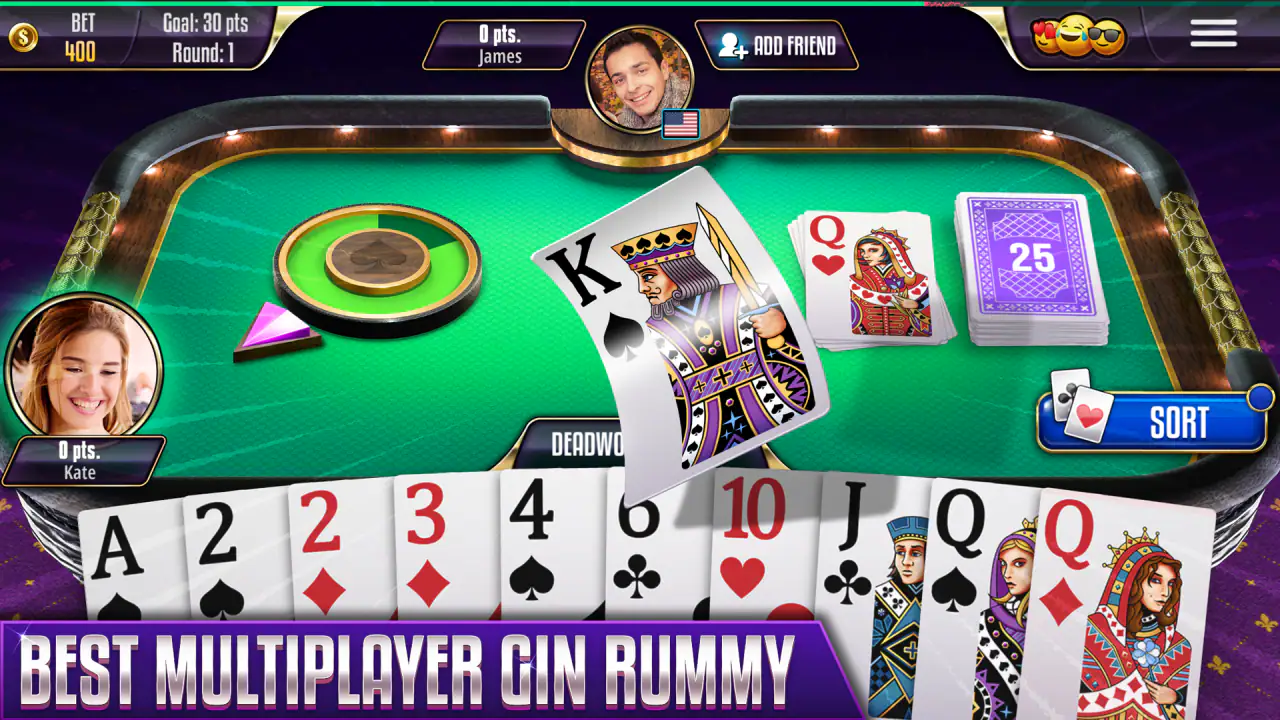
The online format changes the mood compared with a traditional offline card app. A computer opponent can be convenient when I want a predictable practice session, but a human opponent creates uncertainty that is difficult to reproduce. Their choices may be cautious, misleading, or simply different from mine. That unpredictability is where the game feels most alive, although it also means a poor connection or an interrupted session would be more frustrating than in a completely offline alternative.
Progress can motivate, but it can also change the way you play
Card games often become less about learning the rules and more about deciding how much risk to accept. In this one, I noticed that a player can be tempted to chase a perfect-looking hand instead of taking a safer improvement. That is a useful lesson for anyone new to gin rummy: a hand that is almost elegant may still be worse than one that simply reduces loose cards.
When a game includes online competition and optional purchases, I also pay attention to whether progress starts influencing my behavior. Even without assuming a particular reward system, the possibility of spending can make a player feel that every loss needs to be recovered immediately. I recommend setting a personal stopping point before playing several matches in a row. If I lose because I took a calculated risk, I can learn from it; if I keep playing only to erase the feeling of losing, the decisions usually become less disciplined.
That is one of the practical trade-offs here. The game is free to start, which lowers the barrier for trying it, but the listed purchase range reaches $99.99 for an individual item. I would not spend simply because a match went badly. I would first decide whether the free experience already gives me enough enjoyment, then consider any purchase only as an optional convenience or support for continued play. The purchase information alone does not establish that spending is required to compete fairly, so I would avoid treating it as proof of either a generous or aggressive economy.
What I would check before spending
My advice is to play long enough to understand the normal rhythm before buying anything. Pay attention to whether I can enjoy matches without feeling blocked, whether the available pace suits me, and whether the game remains comfortable when I lose several rounds. Those are more useful questions than asking whether a purchase looks attractive in isolation.
I would also avoid buying during a frustrating streak. In a competitive card game, the urge to spend can come from wanting to change the result of the last match, even though the next hand still depends on decisions and chance. A sensible approach is to treat purchases as separate from performance: if I would not want the item after a winning session, I probably should not buy it after a loss.
Because the listed items range from $0.99 to $99.99, family members should discuss spending boundaries before handing the game to a younger player. The Teen rating is another reason to keep expectations clear. It is not the same audience as a very young children's card app, and the competitive online setting may feel more intense than a quiet solitaire game.
Fairness is mostly about what the game does not let me assume
I am careful here because a purchase range does not tell me how purchases affect matches. It does not, by itself, prove that paid items create an advantage, nor does it prove that every competitive element is purely skill-based. I would judge fairness through actual play: can I understand why I lost, do opponents appear to operate under comparable rules, and does progress feel tied to decisions rather than access to something unavailable for free?
From my perspective, the best sign of a fair card game is clarity. I want the result to make sense after the round ends. If I misread the discard pile, held the wrong card, or ignored a safer option, I can accept the loss. If the outcome feels determined by an unclear purchase barrier, the experience becomes less satisfying even when the rules themselves are familiar.
Players who want a completely controlled competitive environment may prefer playing gin rummy with friends using a physical deck or a simple offline app. That alternative removes online matchmaking and reduces questions about spending. The trade-off is convenience: Gin Rummy Legends is more suitable when I want opponents available through a digital game rather than arranging a table in advance.
Compared with solitaire, this game offers more social tension and less control over the pace of success. Solitaire is better when I want to relax alone and reset a board without worrying about another person's decisions. Compared with broad multiplayer card platforms, this title has a narrower identity centered on gin rummy, which is a strength if that is the exact game I want and a weakness if I am looking for several card variants in one place.
Small habits that make the game more enjoyable
My first practical tip is to track the opponent's discarded cards mentally, but not obsessively. I do not need a perfect record of the entire pile. Remembering a few repeated refusals is enough to avoid handing over an obvious completion. This makes the game feel more strategic without turning a short match into homework.
My second tip is to value flexibility early and specialization late. At the beginning, I prefer cards that can connect in more than one way. Near the end, once the available information is clearer, committing to a specific combination becomes safer. This prevents the common mistake of protecting a beautiful possibility while several unhelpful cards remain in the hand.
My third tip is to separate practice goals from winning goals. In one session, I might concentrate on reducing deadwood quickly. In another, I might study how the opponent responds to my discards. That mindset makes losses useful and reduces the pressure to treat every round as a final test of skill.
A fourth useful habit is to stop when attention drops. Gin rummy rewards memory and restraint, so playing while tired can create a misleading impression that the game is unfair or too random. Sometimes the better decision is to close the app and return later, especially after I notice myself discarding without considering what the move reveals.
Who should play it, and who should choose something else
I would recommend this game to someone who already enjoys gin rummy or wants an online version with a focused card-game identity. It is also a good match for players who like learning through repeated short contests rather than unlocking a story. The free starting point makes experimentation straightforward, and the online multiplayer emphasis gives the familiar rules a more active feel.
I would be more cautious recommending it to someone who wants a purely offline pastime, a calm solitaire experience, or a large collection of unrelated card games. The competitive element may not suit a player who dislikes losing to strangers, and the presence of optional purchases means it is worth setting spending limits before regular play.
New players should not judge themselves by their first few matches. The hardest adjustment is learning that a useful card is not always the card that completes the most obvious combination. I found improvement came from watching patterns, discarding with purpose, and accepting a modest hand when the alternative was chasing an unlikely finish.
Device details and the practical decision to install
Ahoy Games released the game on November 23, 2022, and the current version is 1.40.0. It runs on Android 7.0 or later, so owners of older supported devices may still be able to try it without needing a recent phone. The app has passed a meaningful level of adoption, with over 100 thousand installs, and its average rating is 4.7 from around 4.8 thousand ratings. Those figures suggest that the basic concept has found an audience, although they do not replace my own check of connection quality and spending comfort.
The review volume is also substantial enough to show that this is not an obscure experiment, with around 533 written reviews. I interpret that as useful context rather than a guarantee. Card-game satisfaction depends heavily on whether I enjoy the rules, the pace of online play, and the way the app handles the moments between matches.
Before installing, I would ask myself whether I want gin rummy specifically. If the answer is yes, the focused design is appealing. If I am only looking for any casual card diversion, a basic solitaire title may be less demanding and a multi-game collection may offer more variety. The right choice depends less on the rating than on whether I want decisions against another player.
The details I would still keep in mind
There are practical questions I would answer through personal use rather than assumptions. I would check how comfortable the online matchmaking feels during my usual playing hours, how clearly the game communicates outcomes, and whether the free path remains enjoyable over repeated sessions. These checks matter because a short trial can reveal more about fit than a store summary.
I would also pay attention to how I react to the purchase prompts, if and when they appear. A game can be enjoyable while still requiring firm boundaries. Since the available items span a wide range, I would use device-level purchase controls where appropriate and never let a competitive streak decide what I buy.
For someone asking whether the game is suitable for a teenager, my answer would be conditional. The Teen rating means I would not present it as a children's app, and I would explain that online competition and optional spending deserve supervision according to the player's age and maturity. For an adult who understands gin rummy and wants mobile opponents, the same elements are more likely to feel like part of the appeal.
My trust verdict after weighing the good and the friction
My overall view is positive, but it is not unconditional. Gin Rummy Legends succeeds because gin rummy already has an excellent balance of simple rules and difficult choices, and online multiplayer gives those choices immediate weight. I enjoyed the moments when a careful discard mattered more than a lucky draw, especially when I could infer something from the opponent's earlier decisions.
The main caution is not a claim that the game is unfair; it is the need to approach the purchase system thoughtfully. The app is free, yet optional items can cost as much as $99.99 each. I would install it, play without spending first, and decide based on whether the core matches are satisfying on their own. That is the safest way to keep the game about card judgment rather than pressure.
For me, the final recommendation is clear: choose it if you want a dedicated online gin rummy experience and enjoy improving through repeated hands. Skip it if you want offline simplicity, broad card-game variety, or a completely purchase-free environment. The best reason to play is the quality of the decisions between draws, not the promise of buying your way past a disappointing result. With sensible spending limits and a willingness to learn from losses, it is a worthwhile free card game to try.
FAQs for Gin Rummy Legends
What is Gin Rummy Legends, and how is the game played?
Gin Rummy Legends is a digital version of the classic two-player card game, designed for quick matches against computer opponents or other players. The main objective is to form sets and runs while reducing the value of unmatched cards in your hand. You draw and discard cards each turn, trying to “knock” or achieve gin before your opponent does. The app is suitable for both beginners and experienced rummy players.
Can I play Gin Rummy Legends offline?
Availability of offline play may depend on the version and platform you install. In general, card games like Gin Rummy Legends may offer solo matches against artificial-intelligence opponents, while online features require an internet connection. It is worth checking the game’s current store description before downloading, especially if you want to play during travel or in areas with limited connectivity. Online events, leaderboards, and account-related features typically need internet access.
Is Gin Rummy Legends free to download and play?
Gin Rummy Legends can generally be downloaded without an upfront purchase, but the free version may include advertisements, optional purchases, or in-game currency systems. These extras can provide cosmetic items, additional rewards, or other conveniences, depending on the current release. Before playing regularly, review the in-app purchase details and parental controls, particularly if the device is shared with children or connected to a payment method.
Does Gin Rummy Legends support multiplayer matches?
The game is primarily built around the competitive nature of gin rummy and may include multiplayer options such as matches against other players, challenges, rankings, or online tournaments. The exact features can vary between Android and iOS versions and may change through updates. Multiplayer modes usually require a stable internet connection, and some features may only become available after completing tutorials or reaching a particular progression level.
Is Gin Rummy Legends appropriate for beginners?
Yes, Gin Rummy Legends can be a good starting point for players who are unfamiliar with gin rummy, provided they take time to learn the rules and scoring system. A tutorial, practice mode, or matches against easier opponents can help explain melding cards, discarding safely, knocking, and going gin. New players should also remember that winning depends partly on strategy and partly on the cards dealt, so early losses are normal while learning.
Pros
- Smooth controls make card selection and discarding easy on mobile.
- Quick matches are convenient for short gaming sessions.
- Different opponents offer a gradual challenge for new players.
- Clear card visuals make the table easy to follow.
- The classic rules are accessible for casual card-game fans.
Cons
- Some features may be restricted until you progress or spend resources.
- Match difficulty can feel uneven in certain games.
- Random card draws may make outcomes feel frustrating at times.
- The interface can feel busy when several options appear at once.
- Players looking for multiplayer depth may find the experience limited.


